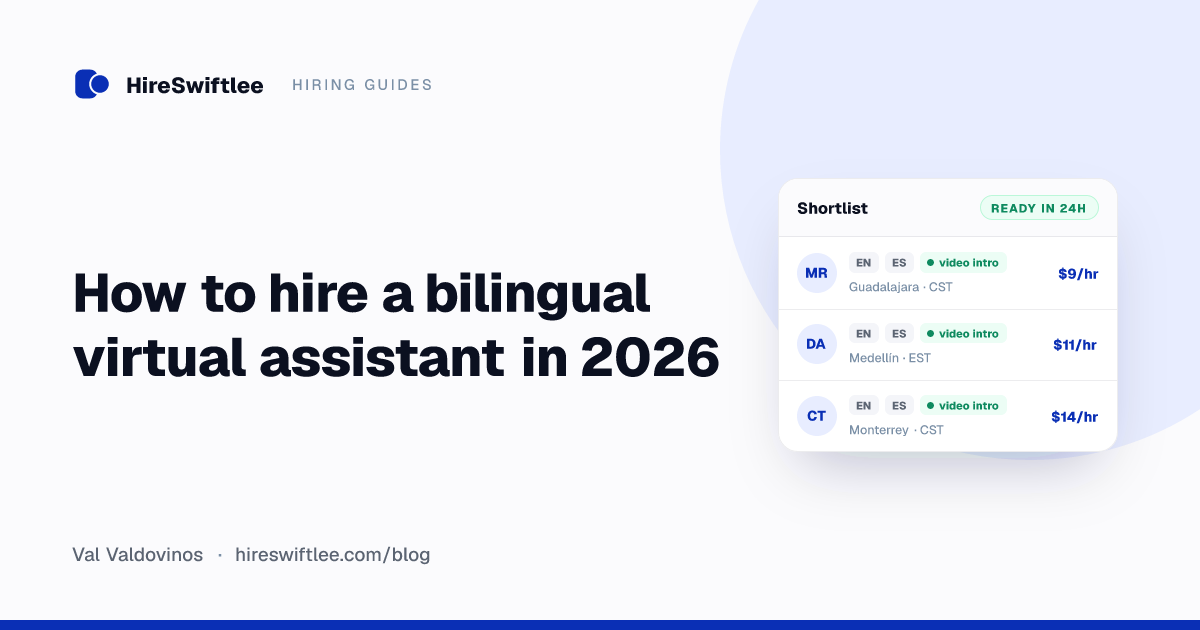
The fastest low-risk way to hire a bilingual virtual assistant is through an Agency of Record: post the role, get a pre-vetted English/Spanish shortlist in about 24 hours, sign one agreement, and the contractor is paid compliantly every week. The rest of this guide covers what a bilingual VA actually does, contractor versus employee, what one costs in 2026, and the four ways to hire — with the trade-offs of each.
- A bilingual (English/Spanish) virtual assistant handles support, scheduling, data entry, and back-office work across the same US time zones — usually as an independent contractor, not an employee.
- The fastest, lowest-risk way to hire one is through an Agency of Record (AOR): you sign one agreement, the talent is vetted and sourced for you, and the contractor is paid compliantly in their own country.
- Expect roughly $8–$15/hour for a strong nearshore bilingual VA in Latin America — a fraction of a US hire, without the offshore time-zone and accent gaps.
- Avoid two mistakes: misclassifying a full-time employee as a contractor, and hiring a stranger off a marketplace with no contract, vetting, or compliant payment.
What is a bilingual virtual assistant?
A bilingual virtual assistant is a remote professional — typically fluent in English and Spanish — who handles ongoing administrative, customer-facing, or back-office work for your business. The "bilingual" part matters when any of your customers, leads, or vendors are Spanish-speaking: one assistant covers both languages instead of two hires.
Most US companies hire their bilingual VA from Latin America — Mexico, Colombia, and nearby countries — because the talent works in the same time zones as the US, with strong English and short cultural distance. This is "nearshore" rather than "offshore," and it's the reason a bilingual VA from the region feels like part of your team rather than a handoff to the other side of the world.
Two facts worth keeping. More than 40 million U.S. residents speak Spanish at home (U.S. Census Bureau, American Community Survey) — so "bilingual support" is a mainstream customer need, not a niche one. And Mexico City and Bogotá both sit within one hour of U.S. Central Time all year, which is why a nearshore VA can answer while the customer is still on the line.
What does a bilingual VA actually do?
The role is broad by design: one person who can carry the recurring work that otherwise interrupts your team. These are the six buckets we see most often.
What a VA should not do is give regulated advice — legal, medical, or financial. Those decisions stay with your licensed staff; the VA runs the intake and follow-up around them.
Contractor or employee? Decide this first
Most bilingual VA work is independent-contractor work, and the structure you choose changes both your cost and your obligations:
- Independent contractor — an independent professional delivering a defined service on their own schedule and tools. The overwhelming majority of bilingual VA work fits here.
- Employee — a core, full-time role where you control the hours, the how, and the where. This is rarer for VA work, and it's Employer-of-Record (EOR) territory.
Don't misclassify to save money. If the role is genuinely full-time employment, treating the person as a contractor to dodge employer costs is misclassification — and authorities in Mexico and Colombia do scrutinize it. Match the structure to the real working relationship, then optimize cost within it.
What are the four ways to hire a bilingual VA?
You can screen a marketplace yourself, hire direct, employ through an EOR, or use an Agency of Record. For genuine contractor roles, the AOR gives you the speed of an agency at the cost of a contractor.
| Route | Speed | Vetting & payment |
|---|---|---|
| Job boards / freelance marketplaces | Slow — you screen everyone | You vet and pay each person yourself |
| Hire direct as a contractor | Medium | You handle the contract, tax forms, and cross-border payment |
| EOR (employ them abroad) | Medium | Compliant employment — but overkill for contractor work |
| Agency of Record (e.g. HireSwiftlee) | Shortlist in ~24 hours; working hire in about a week | Vetted shortlist + one agreement + compliant weekly pay |
For genuine contractor roles, an AOR gives you the speed of an agency with the cost of a contractor.
How much does a bilingual virtual assistant cost?
For a strong nearshore bilingual VA in Latin America, plan on roughly $8–$15 per hour, depending on the seniority and specialization of the role. A specialist (bilingual bookkeeping, technical support, paralegal-style intake) sits at the higher end; general admin sits lower. Through an Agency of Record, you typically pay the contractor's rate plus a flat agency margin, billed in USD — with no EOR-style per-employee employment fee, because there's no employment relationship.
Compared with a US-based assistant at $25–$40+ per hour, or an offshore hire where the time-zone gap quietly costs you a day on every back-and-forth, a nearshore bilingual VA is usually the best value per hour worked alongside you.
How do you hire one, step by step?
Write a one-page scope
The tasks, the tools, the hours of overlap you need, and the languages — in that order.
Decide the structure
Contractor for defined independent work; EOR only if it is genuine employment.
Source vetted candidates
Either screen a marketplace yourself, or let an Agency of Record send a pre-vetted shortlist.
Run a short paid trial task
See real work — a sample inbox, a mock call, a data-entry batch — before you commit.
Sign one agreement and pay compliantly
Collect tax documentation (W-8BEN) and pay in the contractor's local currency on a set weekly cadence.
How does hiring through an Agency of Record work?
You sign one agreement and get one invoice; the agency holds the contract with the contractor, collects their tax form, and pays them in their own country. You still manage the person's day-to-day work directly — the agency sits underneath the relationship, not in the middle of it.
With HireSwiftlee, that means one Master Services Agreement; we source and vet the bilingual talent before you see the shortlist; we contract the professional in their country, collect their tax forms, and pay them weekly in local currency via Wise. You're billed in USD and manage one relationship — not a dozen freelancer invoices. (HireSwiftlee is an Agency of Record, not an EOR.)
FAQ
How much does a bilingual virtual assistant cost?
Where is the best place to hire a bilingual virtual assistant?
Is hiring a bilingual VA as a contractor legal for a US company?
What is the fastest way to hire a vetted bilingual virtual assistant?
What tasks can a bilingual virtual assistant handle?
Hiring contractors, not employees abroad?
HireSwiftlee finds, vets, contracts, and pays bilingual nearshore talent — a flat 15% on top of the contractor rate, no per-seat SaaS fees. Post a role and see a ranked shortlist within 24 hours.
HireSwiftlee is a recruiter-driven marketplace and Agency of Record for independent contractors — not an Employer of Record. Competitor product names and pricing are referenced for comparison, are accurate to the best of our knowledge as of publication, and may change — always confirm current details on the provider's own site.